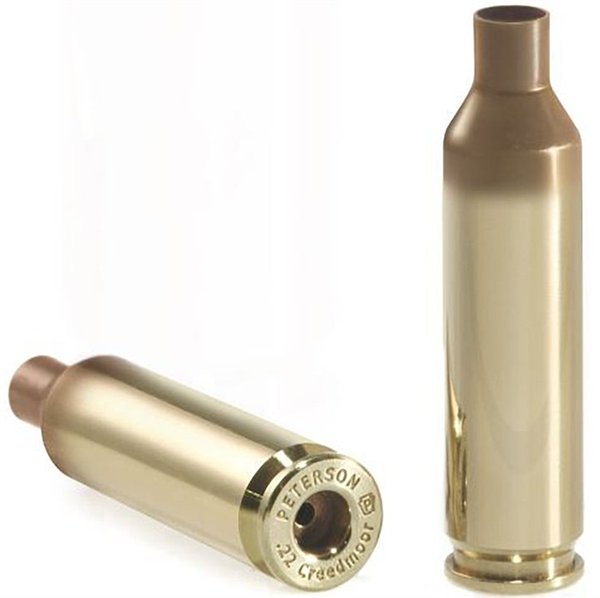
According to Derek Peterson, president of Peterson Cartridge, “We decided to build the tooling to make .22 Creedmoor brass in response to the uptick in long-distance predator and varmint hunting. Plus the round is just straight-up fun to shoot. It is a low-recoil, flat shooting, wind-bucking round; deadly accurate up to 800 yards.” Peterson Cartridge also makes 6.5 and 6mm Creedmoor casings. “But when we designed the tooling for the .22 Creedmoor we set out to make casings with improved features,” Peterson stated. “And we were successful. We increased the head hardness to tolerate higher pressures. And we increased our internal volume slightly to work better with the slow burning powders (like RL 26, or H1000) which people favor for this round.” Prior to this, shooters had to take 6mm or 6.5 Creedmoor casings and neck them down to .22. There are a few problems with necking down. When you take a larger caliber with the correct neck wall thickness and neck it down to a smaller caliber, that excess brass bunches up in the neck. It creates a tension band, what some people call a doughnut of brass in the neck, which has a negative effect on loading, bullet release and accuracy. A trait of cartridge brass is that it work-hardens – which is to say the brass gets harder each time you “work it.” So the effect of necking down a casing which has been properly annealed, is that after you “work” it, it is no longer properly annealed. Finally, necking a larger caliber into a smaller one results in neck walls that are too thick. The ideal neck wall thickness for a case the size of .22 Creedmoor is .0143 to .0148. Necking down results in neck walls thicker than that. But the Peterson .22 Creedmoors all fall within that ideal spec. Peterson worked with Derrick Ratliff of Horizon Firearms on the particulars of the casing. Horizon has been chambering guns in .22 Creedmoor since 2014. Horizon has been a pioneer in helping move the .22 Crd. from an unknown wildcat to the popular caliber it is today.
Scopri la nuova cartuccia .22 Creedmoor Brass di Peterson Cartridge!
Secondo Derek Peterson, presidente di Peterson Cartridge, “Abbiamo deciso di costruire gli attrezzi per realizzare la cartuccia .22 Creedmoor in risposta all'aumento della caccia a lungo raggio a predatori e animali da preda. Inoltre, il calibro è semplicemente divertente da sparare. È una cartuccia a basso rinculo, con tiro piatto e capace di affrontare il vento; letalmente accurata fino a 800 yard.”
Peterson Cartridge produce anche bossoli per 6.5 e 6mm Creedmoor. “Ma quando abbiamo progettato gli attrezzi per il .22 Creedmoor, ci siamo posti l'obiettivo di realizzare bossoli con caratteristiche migliorate,” ha dichiarato Peterson. “E ci siamo riusciti. Abbiamo aumentato la durezza della testa per tollerare pressioni più elevate. Inoltre, abbiamo leggermente aumentato il nostro volume interno per funzionare meglio con le polveri a lenta combustione (come RL 26 o H1000) che le persone preferiscono per questo calibro.”
In precedenza, i tiratori dovevano prendere bossoli da 6mm o 6.5 Creedmoor e ridurli a .22. Ci sono alcuni problemi con la riduzione. Quando prendi un calibro più grande con lo spessore corretto della parete del collo e lo riduci a un calibro più piccolo, il rame in eccesso si accumula nel collo. Questo crea una banda di tensione, ciò che alcune persone chiamano un "doughnut" di rame nel collo, che ha un effetto negativo sul caricamento, sul rilascio del proiettile e sull'accuratezza.
Una caratteristica del rame per cartucce è che si indurisce – il che significa che il rame diventa più duro ogni volta che lo “lavori.” Quindi, l'effetto di ridurre un bossolo che è stato correttamente ricotto è che dopo averlo “lavorato,” non è più correttamente ricotto.
Infine, ridurre un calibro più grande in uno più piccolo porta a pareti del collo troppo spesse. Lo spessore ideale della parete del collo per un bossolo delle dimensioni del .22 Creedmoor è di .0143 a .0148. Ridurre porta a pareti del collo più spesse di così. Ma i .22 Creedmoor di Peterson rientrano tutti in quella specifica ideale.
Peterson ha collaborato con Derrick Ratliff di Horizon Firearms sui particolari del bossolo. Horizon ha iniziato a produrre armi in .22 Creedmoor dal 2014. Horizon è stata pioniera nell'aiutare a far passare il .22 Creedmoor da un wildcat sconosciuto al calibro popolare che è oggi.
 Aiuto e contatti


 Newsletter








 Visualizzazione classica
 Visualizzazione mobile